Hall Place has been a working estate for the better part of a thousand years — a manor in Saxon Kent, a Tudor grant, a Georgian rebuild, and finally the great Tudor Revival mansion George Devey designed for Samuel Hope Morley MP in 1870–72. Fire, storm and the changing century have each left their mark. This is the story, moment by moment.
Estate history timeline
-
Pre-1066
Early History
Dens and droves: the Wealden landscape
Much of the land that became Leigh consisted of seasonal pasture (dens) attached to north Kent estates — Penshurst's dens belonging to the Archbishop of Canterbury's Otford estate, with the Kemsing outliers forming the manor of Leigh Hollanden to the east. An Iron Age gold coin found in the locality hints at far older activity.
-
1115
Medieval
First records: Stephen de Penshurst
Penshurst (absent from Domesday Book) is recorded as held by Stephen de Penshurst by 1115; in 1316 a patent roll mentions "a park at Leigh" within the Penshurst lands — possibly the first enclosed ground where Hall Place now stands.
-
1424
Medieval
The manor of Leigh Hollanden
Hollanden's first court rolls date from 1424; the place-name appears from 1270. The manor's ~300 acres would later be acquired by the holders of Hall Place.
-
1521-27
Tudor & Stuart
A manor is born: Buckingham's fall
After the third Duke of Buckingham was beheaded in 1521, the Crown surveyed his forfeited estates and the steward Charles Knevett acquired "Hall Place in Lye… enclosed in pale" (1522). By 1527 it was a manor of 260 enclosed acres, its capital messuage called "the Halle place".
Hall Place Estate archive -
1520s
Tudor & Stuart
The Boleyn connection
Thomas Lord Rochford — Anne Boleyn's father — buys Hall Place. After the Boleyn family's fall the estate reverts to the Crown, which grants it to William Waller of Groombridge Place; his son Richard gives the property its lasting name association.
-
1663-1717
Tudor & Stuart
The quiet centuries
The Cruttendens hold the estate to 1663, then the Harrisons, who let it as a farm. Abraham Harrison's will of 1717 leaves "my farm called Hall Place… 240 acres" — no park mentioned. The grandeur sleeps.
-
1780
Georgian
The Burgess rebuild
Isaac Burgess acquires the estate through his wife; their son Robert is given it in 1753 and rebuilds the house in 1780 — a substantial Georgian mansion set in a parterre behind an elaborate metal fence, in a paled park whose boundaries we still walk.
-
1820-70
Victorian
The Baily era
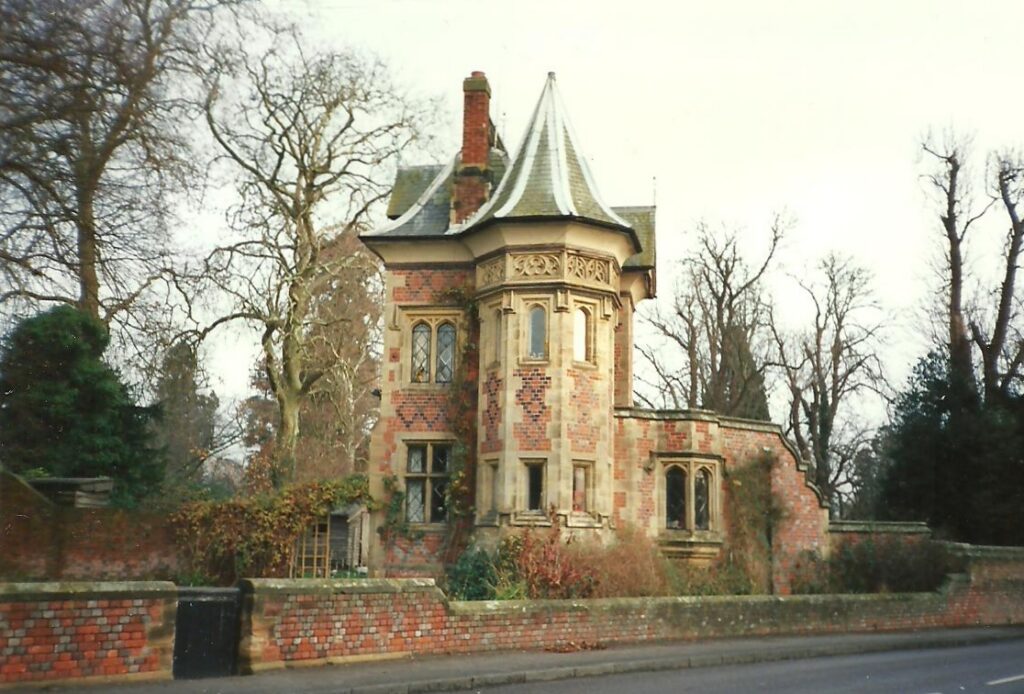
The Baily family: a 70-foot Gothic Hall added in 1846, the house nearly doubled, the ornate gothic gateways at East Lodge and Old Lodge, farms bought northwards, a summer drive to Stocks Green — and George Devey employed on the estate from 1864, with the Walled Garden completed by 1870.
-
1870-73
Victorian
Morley buys; Devey builds his largest house
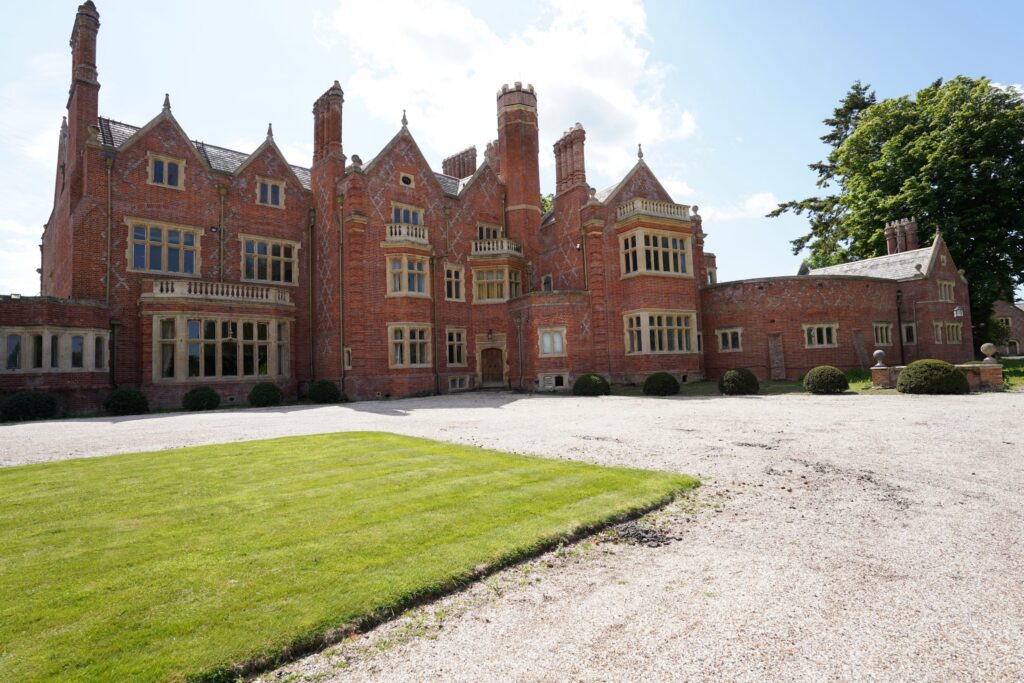
Samuel Morley MP — hosiery magnate, severe nonconformist — chooses Hall Place over Redleaf. Devey first plans an extension (nine bedrooms, a first-floor pool), then Morley opts to rebuild: the mansion rises 60m northwest of the old house and is completed by September 1873, the largest house Devey ever designed.
-
1871-77
Victorian
Marnock's lake and the Mound
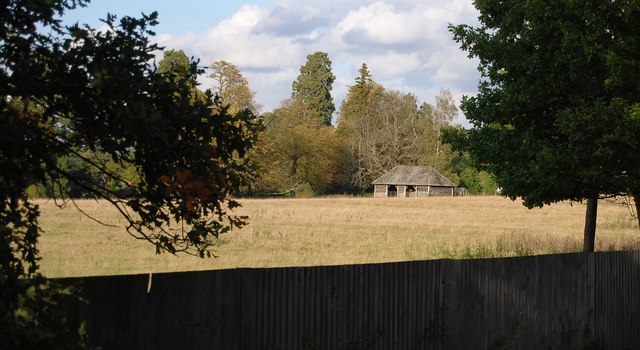
Earthworks begin in June 1871 for a lake of some 13 acres; the Mound is raised from the mansion's foundation spoil to carry a 1,000-gallon tank feeding half a mile of hydraulic piping. The boathouse is thatched in 1874; The Garden magazine records the whole scheme in 1877.
Geograph / CC BY-SA 2.0 -
1872
Victorian
The Baronial Hall moves to the village
In keeping with his nonconformity, Morley moves the mansion's own Baronial Hall to the High Street as a chapel, provides the schoolhouse (now the Small Village Hall) and the Baptistry (now the Royal British Legion Club), and runs estate gasworks until 1940. Leigh becomes a true estate village.
-
1886-1912
Victorian
The Hope-Morleys and Lord Hollanden
Samuel Morley dies in 1886; his son Samuel Hope-Morley inherits, and is created the first Lord Hollanden in 1912. By 1900 Country Life finds the landscape mature, its East Drive lined with a complete horse chestnut avenue.
-
1910-11
1900s-1945
The Rose Garden and coronation cedars
The Rose Garden is laid out with its pergola and summerhouse in 1910, a great Wellingtonia moved bodily to the East Lawn. In 1911 an avenue of cedars is planted to mark the coronation of George V.
-
1925-30
1900s-1945
The gardeners' lord and the £40,000 garden
The second Lord Hollanden keeps 15-20 gardeners and 18 greenhouses — three men growing nothing but oranges, bananas and grapes — and opens the gardens to the public six days a year from 1930. His Pavilion Garden of 1929 costs £40,000; in 1930 the timber lake bridges are replaced in stone.
-
28 Nov 1940
1900s-1945
The November fire
An electrical fault sets fire to the mansion, destroying its northern third. Hall Place was never requisitioned and escaped the bombs — the burnt shell stands as a ruin for a third of a century.
-
1947-1960s
Post-war
The productive years
The kitchen garden, Walled Garden and nursery are in full production, feeding the village with locally sold produce — until the 1960s, when the deer herd's management is abandoned and the glasshouses fall silent.
-
1971-76
Post-war
Roper, and the Inner Garden
Lanning Roper advises on the gardens in 1971 (his report rests in the RHS Lindley Library). In 1975-76 the fire ruin is reduced to fifteen-foot walls and reborn as the Inner Garden; the mansion's interior is remodelled.
-
1987
Post-war
The Great Storm
The October storm fells 87 trees across the estate, among them a great Austrian pine and three weeping limes — the deepest single cut the landscape has taken in living memory.
-
1999-2015
Post-war
The long afternoon
Economies follow economies under the third Lord Hollanden; the fourth succeeds in 1999; and in 2015 the property is sold, closing 145 years of Morley family ownership.
-
2025
Today
A new chapter
The estate begins a new chapter in private family ownership — its buildings, park and village place cared for into the future.
Sources: the National Heritage List for England (entries 1258589, 1000934) and the Parks & Gardens UK record for Hall Place.