The Registered Park & Garden
Every old estate keeps two archives. One sits in the estate office, in maps, deeds and plans; the other is written across the ground itself — in earthworks under turf, in bricks hidden in hedges, in trees old enough to remember houses that no longer exist. Hall Place has now had both archives read, cover to cover: a gazetteer of sixty-seven archaeological features, a survey numbering the estate’s trees one by one, and a register of the trees that are nationally important. Together they amount to a portrait of the place no photograph can give.
Sixty-seven ways into the past
The gazetteer is the estate’s buried inventory, compiled from historic records and a detailed walk-over survey in the spring of 2023. Its entries run from the obvious to the almost invisible. At one end stand the great structures: the mansion, the stable block with its 1872 datestone, the earthen dam two to three metres high, the boathouse mapped on its present spot since at least 1897. At the other end are features nobody would notice unaided: a metalled footpath sleeping under grass, field boundaries traceable now only by lidar, the faint square quarters of a nursery garden last mapped in 1937.
Some of the finds are pure character. In the Rookery, beside the remains of the old timber yard, stands the estate’s tar pit — a brick tank with its own chimney, where tar was once heated to dip the ends of hop poles and other timbers against rot. The iron tank inside still holds rainwater beneath an oily film; the chimney keeps its pot; the damping plate rusts in place. The survey calls it an unusual survival worth retaining, and it is hard to disagree: hop farming and estate forestry do not usually leave monuments, but here one has. Its neighbour, the corrugated-iron woodshed, is the gazetteer’s one verdict of demolition — derelict, close to collapse, its concrete base undermined by burrowing animals.
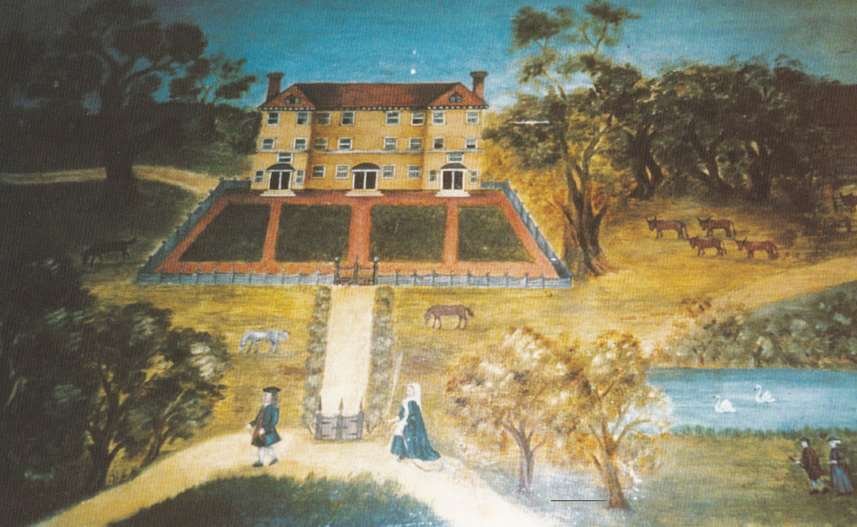
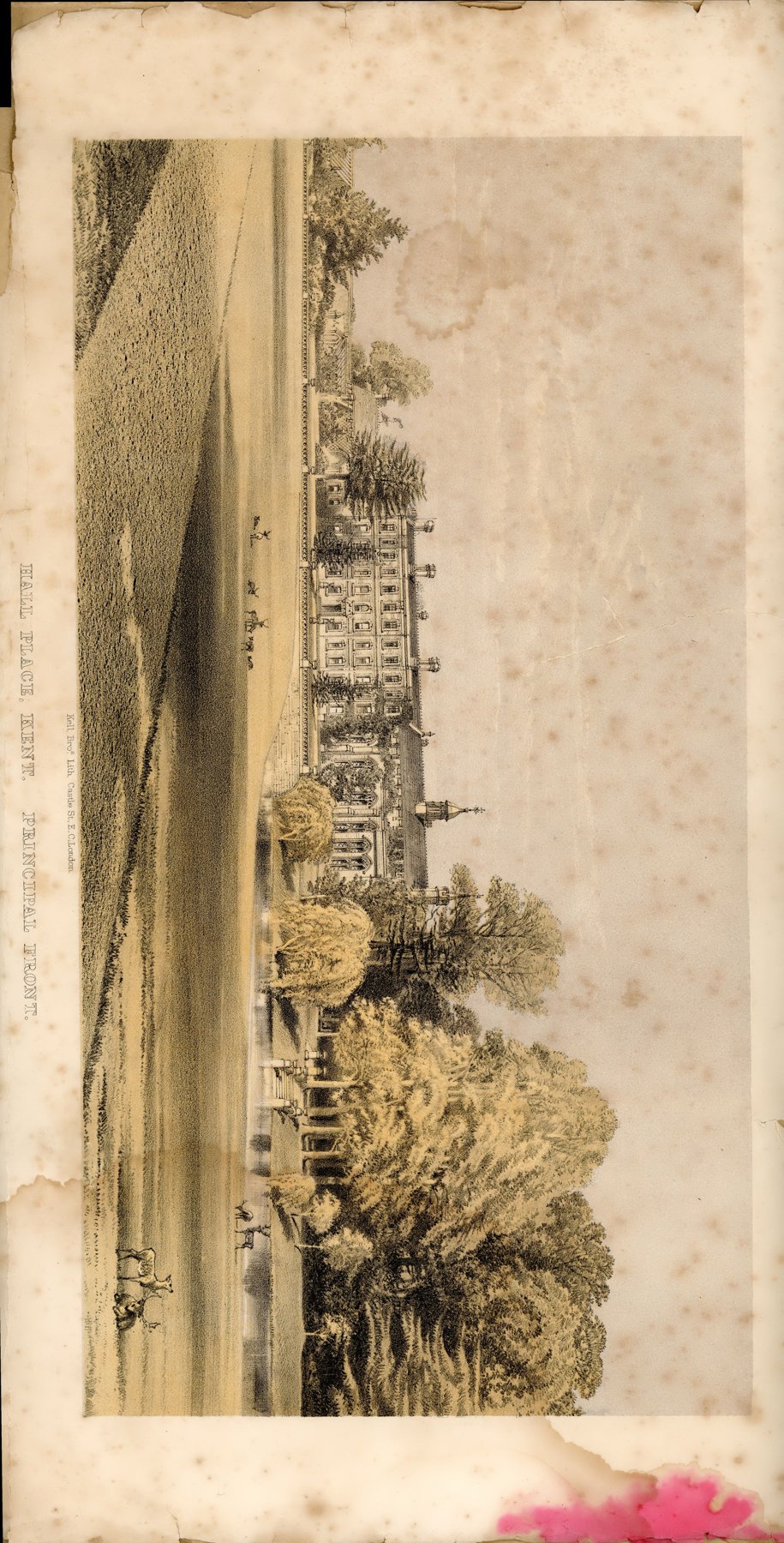
The most haunting entry needs no imagination to picture. The old eighteenth-century house that stood until the early 1870s has left no visible trace: its site is a flat lawn, mowed twice a summer, in front of the present mansion. Beneath the grass, its foundations almost certainly survive. The survey recommends geophysical survey and ground-penetrating radar to map them — a buried floor plan waiting for its reading. Nearby, two sets of ‘lazy beds’ identified from the air have been reinterpreted as probable modern drainage features: the estate’s archaeology includes its own false leads, followed and corrected.
The water empire underground
The gazetteer’s most surprising chapter is hydraulic. Hall Place once ran its own water company. The Mound’s tower — a brick tank partly sunk into the summit, a circular pit ten metres across holding a free-standing tower with conical roof and ball finial, braced by six horizontal iron straps — headed the system, and the survey notes that its site doubles as a viewing mount, partly heaped over the demolished old house. Down the hill, a second cement-rendered tank stands on a hillock overlooking the village rooftops; in another pasture a grassy mound hides a cistern where flowing water can still be heard beneath an iron grille; and a brick-lined well nearby is covered only by a wooden pallet — flagged in the survey as unsafe, and first on the estate’s make-safe list. Fountains and drinking troughs on the village High Street once drank from the same source. This is industrial archaeology in miniature, hidden in lawn and parkland.
Reading the ground
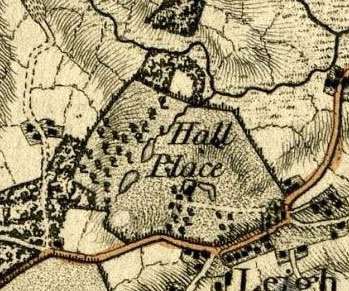
Walk the park with the survey in hand and the grass begins to speak. The terraced track cut into the slope near the church — visible on county maps from 1769 until the 1870s — was the original drive from East Lodge, abandoned when the new house turned its back on the old approach. A low bank along the park’s north-eastern edge marks a double avenue, planted by the 1870s, gone by 1897. In Cherry Orchard, lidar reveals a medieval field system beneath the pasture: dog-legged banks, former hedgerows now lines of oaks, and the double-banked line of an earlier park boundary that matches the 1801 county map — evidence that the park once reached further than it does today. Holly-lined boundary banks run through the Rookery; a woodbank predating the 1870s encloses Price’s Wood; and beside the outer kitchen garden a single large sandstone boulder — the only one on the estate — sits split in two by a tree, possibly a rustic antiquarian ornament carried here deliberately, as so many Georgian landowners carried theirs.
Even the garden furniture is inventoried. A curving stone seat closes the Long Walk’s south-western end between conifer hedges and disused iron gates; the Dutch Garden’s fountain, its central bowl broken, still plays water; and below the mansion the summerhouse survives as a gabled brick wall faced in crazy-paving stonework, with attached classical columns and Gothic corbels carved with foliage, griffins — and a turtle. A stone lion crouches on its northern wall, watching the lake it once fronted.
The counted trees
The second archive is botanical. The estate’s tree survey numbers its subjects individually, and the numbers alone tell stories: a veteran sweet chestnut among the garden’s frame trees girths 2.4 metres; a boundary oak with three stems measures 2.86; the Wellingtonias of the West Drive row reach 2.5 metres round; coast redwoods measure two; the great Pallida lime 2.2. At least sixteen trees predate 1820, and the old avenue oaks — survivors of the Victorian replanting that gave the estate its skeleton — reach two metres in girth. The survey also keeps the roll of honour: 87 trees lost in the Great Storm of 1987, including a great Austrian pine and three weeping limes; 54 species and varieties counted back in 1984; and the two coronation avenues, cedars for George V in 1911, horse chestnuts for George VI in 1938, planted as acts of quiet patriotism along the drives.
Victorian gardening showmanship survives in the record too: when the lake planting went in, mature horse chestnuts were transplanted in full leaf, and an account of 1877 already found a Monterey pine forty feet tall — the estate planted big, and expected it to work.
The champions
The third archive is the one that stops visitors mid-stride. Twenty-three of the estate’s trees are registered as champion trees — nationally notable specimens of their kind, recorded on the Tree Register across three decades from 1983 to 2014. The list runs from the grand to the exquisite. The headliner is a giant sequoia standing some 34 metres tall with a trunk girth of about 8.6 metres — a tree whose trunk alone is wider than most rooms in the mansion. Two red oaks follow, around 28 metres tall with girths of 6.6 and 5.4 metres; another common oak is registered by girth alone at 7.25 metres, a circumference to walk around slowly.
But the register’s poetry is in its variety. A double horse chestnut, ‘Baumannii’ — the sterile, flower-laden chestnut that never seeds — stands champion at 27 metres. There is a champion hornbeam and a champion wild service tree, a pin oak at 25 metres, an atlas cedar of the blue-leaved Glauca group at 6.8 metres girth, an incense cedar and a Wisselii Lawson cypress, a purpureum sycamore and a cut-leaved alder, a weeping pear, a black mophead of a liquidambar, two crab apples, a snowbell tree, a strawberry tree from the Pacific coast, and a hawthorn champion at 16 metres — a species most people never see beyond hedgerow height, here a twenty-year-record giant. Salix fragilis, the crack willow, completes the list at 23 metres. One garden holds a national best-of-breed collection assembled not by design but by 150 years of planting well and letting trees stand.
Why it matters
Taken together, the three archives say the same thing from different directions: Hall Place is a complete survival. The turf keeps the roads and fields of its medieval and Georgian past; the buildings keep the full working sequence of a Victorian estate; and the trees — veterans, coronation avenues, champions — carry the whole story standing up. A landscape that can still show its own tar pit, its own buried floor plan, its own water empire and twenty-three national champions is not merely well kept. It is one of the most fully documented private landscapes in the county, and it now knows it.
This page draws on the estate’s Conservation Management Plan (2023) and the National Heritage List entries for Hall Place and its registered park.