Tudor & Stuart
Hall Place first steps into the light of written history in the 1520s, and it steps in fully formed: a moated house in a paled park, with a name already centuries old. The Tudor documents catch it at a moment of change, but everything they describe — the manor, the land, the moat, the very word ‘place’ — reaches back into the middle ages. To understand the Tudor manor is to stand with one foot in each world.
Consider the name itself. ‘Place’, in this part of Kent, was a fashion of the mid-fourteenth century: Penshurst Place is so called by 1341, Hadlow Place by the early sixteenth century, and the term usually meant a building of some importance — perhaps a manorial centre. That was evidently the case here, although curiously, no manorial records for Hall Place have ever been found. The name promises a manor house; the archive holds only the name. What the name also promises, the surrounding manors help to deliver. The manor of Leigh Hollanden, whose lands lay to the east, first appears under that name in 1270, and its first surviving court rolls date from 1424. At some point the holders of Hall Place acquired the manor of Hollanden, containing about 300 acres, and it passed with Hall Place thereafter on inheritance and purchase. The family that sat at Hall Place thus enjoyed the revenues of at least one manor besides its own — an assortment of land, rents and woods sufficient to support a capital messuage and, in the striking contemporary vocabulary of the 1527 indenture, a ‘mancion’.
That 1527 document is the earliest close description the estate possesses. In that year Hall Place was formally called a manor, comprising 100 acres of land, 100 acres of pasture, 40 acres of meadow and 20 acres of woodland, together with rents of 40 shillings in Lee — a holding worth £8 13s. 4d. The same year an indenture, dated 24 September in the seventeenth year of Henry VIII, refers to a capital messuage and ‘mancion’ called ‘the Halle place’. An earlier reference of 1522 calls it ‘Hall Place in Lye and land there now enclosed in pale’ — a house in the old Penshurst satellite park of Lye, its grounds already fenced. Read carefully, the numbers tell a story. The 100 acres of land ‘always meant arable land at this time’, and arable would generally not be enclosed within a pale. It is the remaining 160 acres — pasture, meadow, wood and moated house — that were enclosed, and that area corresponds remarkably closely with the park as it was first mapped in 1798 and as it remains today. In other words, the park that visitors still look across from the village street was very likely already enclosed in the 1520s, in substantially its modern shape.
How the house and park came into these hands is a story of court politics at the highest level. The Penshurst estate, from which the Hall Place lands derive, had been bought early in the fifteenth century by the Duke of Bedford, son of Henry IV, and passed to his brother the Duke of Gloucester, reverting to the crown on Gloucester’s death. In 1461 Henry VI granted it to Humphrey Stafford, Duke of Buckingham. The Stafford ascendancy ended on the scaffold: in 1521 the third Duke of Buckingham was accused of conspiring the death of Henry VIII, was beheaded, and his lands were forfeited to the Crown. When the confiscated estates were surveyed, the Duke’s own steward, Charles Knevett, seems to have acquired Hall Place out of the wreckage. A steward profiting from his master’s fall is the sort of detail no novelist would need to improve.
Within a few years the property changed hands again, into the most famous name in its early history: it appears to have been purchased in the 1520s by Thomas Lord Rochford — Anne Boleyn’s father. The connection with the Boleyns is brief but pregnant. When the Boleyn family fell with Anne herself, Hall Place reverted to the crown, and there begins what the estate’s own records freely admit is a centuries-long period of very little information, in which the ownership of the property is nearly all that can be traced. The crown granted it to William Waller of Groombridge Place, though there seems to have been an earlier connection of that family — William’s uncle, John, may well have been the tenant in the years before. William Waller gave the property to his second son, Richard, whose widow married Stephen Towse, and from the Towse connection the estate passed to the Cruttenden family, who held it until 1663. In that year it was sold to John Harrison.
The Harrisons were absent landlords. John Harrison seems to have let the property for much of the period up to his death in 1705, and his son Abraham followed the same course — the house passing from tenant to tenant while its owners collected the rents. Abraham’s will of 1717 gives a last, unvarnished glimpse of the property as the Tudor manor lapsed into farmland: he leaves to his son James ‘my farm called Hall Place now in the possession of William Heath together with the barns and 240 acres of land’, and also ‘a house called The Porcupine’ with five acres. Strikingly, the will makes no mention of a park. Nearly two centuries after the surveyors described a manor of 260 enclosed acres, Hall Place was being described as a farm — though the Porcupine, whose listed building still stands by the entrance drive, preserved the memory of better days. William Heath bought the property shortly afterwards, and out of that purchase the Georgian estate would grow.
Of the Tudor house itself, the strongest evidence is still the moat. The moated enclosure appears on the tithe map of 1841 and was later partially remodelled as a landscape feature, so the medieval water-supply of the first house survives, in fragments, inside the Victorian garden.
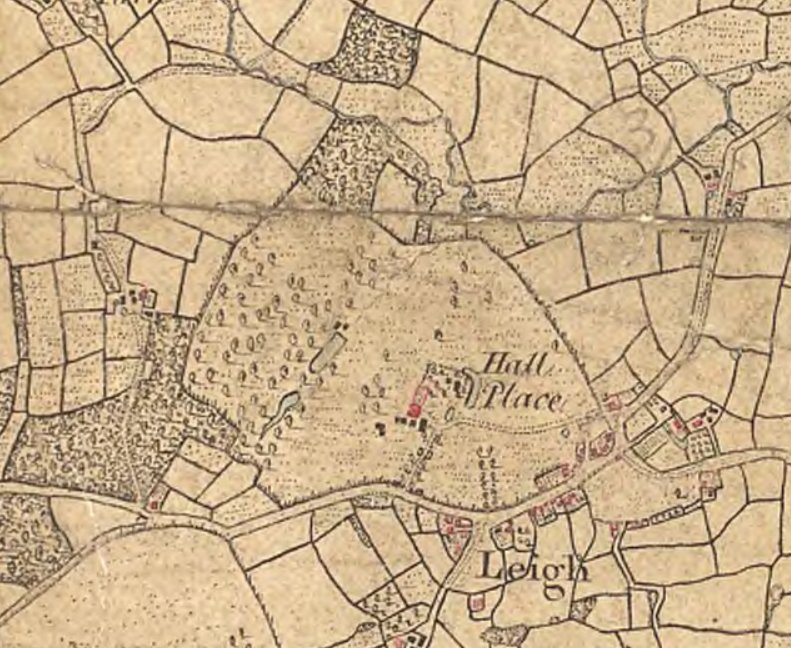
Moats are common in this locality: there are three others in the immediate neighbourhood, at the vicarage, at the scheduled site at Great Burnetts, and at Leigh Park Farm. The Great Burnetts site has been excavated, revealing two medieval timber-framed houses within a rectangular enclosure, occupied in the late thirteenth and early fourteenth centuries and then abandoned — a reminder that the moated house was the normal gentleman’s dwelling of this district in the later middle ages. At first sight the surviving moat at Hall Place looks like the same kind of site; but if it had been complete, the island inside would have exceeded a hectare, which would be exceptionally large. The better reading is that the moat was of the partial type, with an open western edge. The ground levels help to confirm it: the veteran trees in the gardens, at least 350 years old, stand on unaltered levels, which means the land west of the known moat has stayed much the same since at least the late seventeenth century.
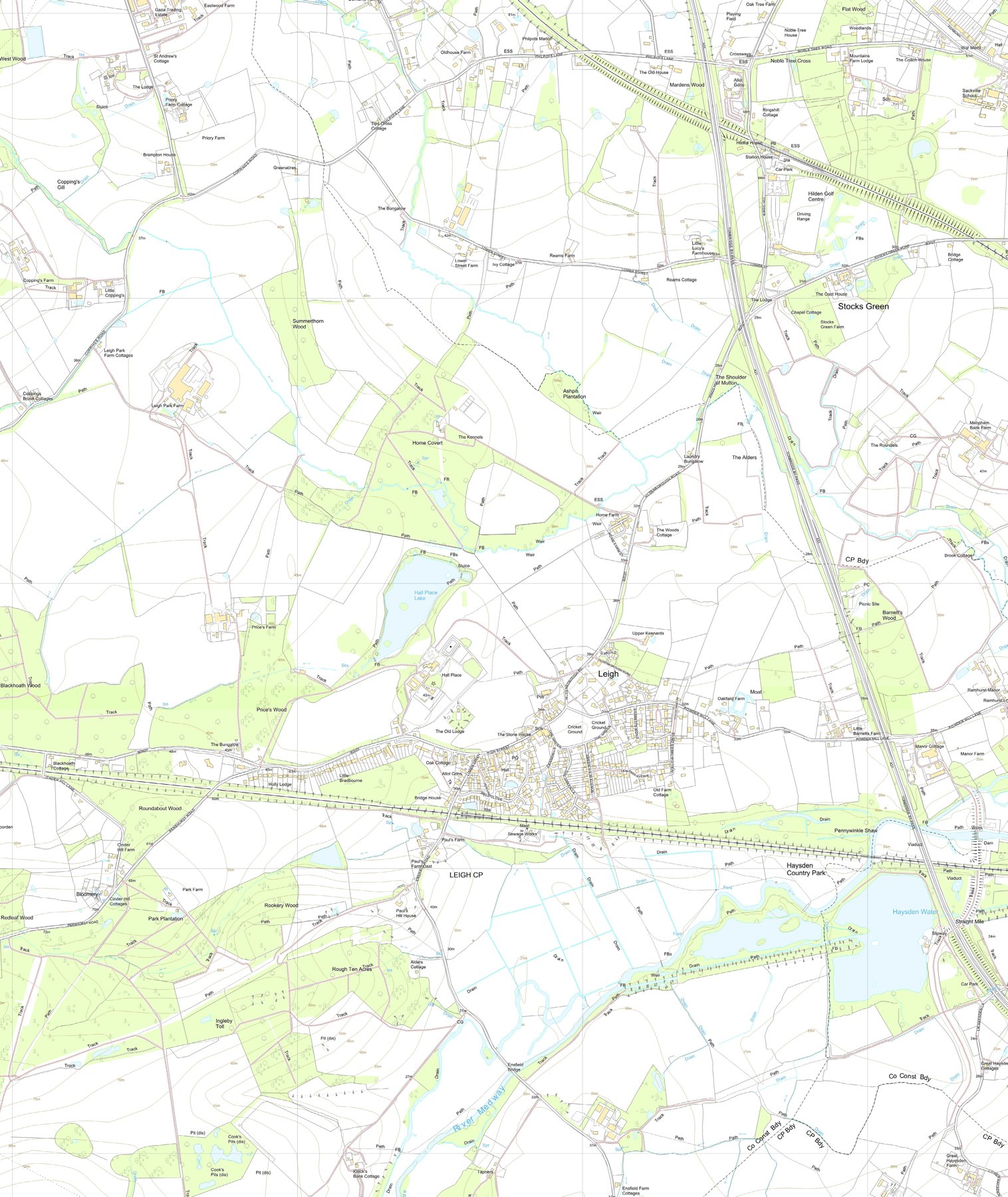
Two more things descend from the Tudor manor to the estate of today. The first is the park’s southern boundary, whose alignment is typical of the way parks were ‘pushed out’ to give a great house more privacy and space — in the medieval and early post-medieval period it was common for public roads to run very close to the big house, and the original road at Hall Place may have run north of the church, on a curving line towards the site of the Old Lodge, more or less along the track shown on later maps. The realignment of that boundary may belong to the turnpiking of the highway through Leigh in 1765, but the impulse to keep the world at arm’s length from the house began in the paled park of the 1520s. The second inheritance is simpler and more durable: a name. ‘Hall Place in Lye’ — a great house, moated, in a walled park, rich in meadow, pasture and wood — is recognisably the same place that stands beside Leigh church today, five hundred years on from the beheading that first put it in the record books.
This page draws on the estate’s Conservation Management Plan (2023) and the National Heritage List entries for Hall Place and its registered park.