People
When W S Gilbert penned the line "A policeman's lot is not a happy one" back in 1880, he could scarcely have imagined how aptly it would describe the working lives of the men who policed a small Kentish village like Leigh. Yet for nearly a century, the village constable was a familiar and much-valued figure here, known by name to almost everyone, living among the people he served and dealing with everything from agricultural regulations to wartime danger. The story of Leigh's village policemen between 1900 and 1990 is a story of changing times, changing uniforms and, eventually, the disappearance of a way of life.
The earliest of these officers whose memory survives is PC Austin, who served the village before the First World War. He was a figure of the old school, dressed in knee-breeches and puttees in the traditional manner. His beat was covered largely by bicycle, and much of his work was of a distinctly rural character. He rode around the parish pinning up notices about sheep dipping and about Swine Fever, both matters of real consequence to farming families in the years before the war. He was also kept busy cautioning local people for riding their bicycles without lights, an offence taken seriously in the dark lanes of the Kentish countryside. PC Austin remained at his post until about 1921, closing an era in which the village bobby on his bicycle was the very image of rural law and order.
He was followed, by the mid 1920s, by PC Post, who took up residence at No. 1 Forge Square, a house that would become something of a traditional address for Leigh's policemen. It was in these years that the Fautly sisters, Dorothy and Kath, had their memorable encounter with village crime. A man had exposed himself by the railway bridge near Leigh, and it was the Fautly sisters who later spotted the same individual at Tonbridge station, an incident that lingered long in village memory.
During much of the 1930s, the occupant of 1 Forge Square was PC Eddie Ginn, who became one of the best-remembered of all Leigh's constables. His neighbours at No 2 Forge Square were Harry and Jack Lucas, so the little square was a close-knit community in those days. Ginn was a man of resourceful and independent habits. On the allotments he grew his own tobacco, and he dried the leaves by the Forge before rolling them into large cigars, a sight that must have raised eyebrows and smiles in equal measure. Joan Coomber, who was born at The Brickmakers Arms, remembered him well, as did Doreen Brooker, whose recollection of PC Ginn was of a strict man who kept firm order in the village.
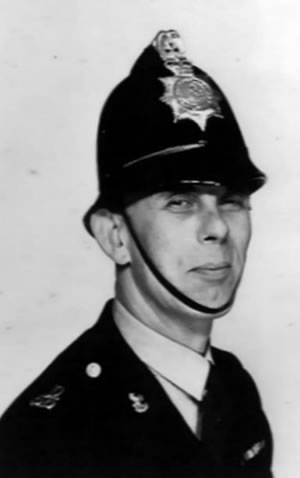
The last of the Forge Square policemen was PC George Cornelius, who served in Leigh from about 1937 to 1948 and lived, like his predecessors, at 1 Forge Square. Cornelius had known hardship before he ever came to the village. He had been gassed in the trenches during the 1914-18 war, and his police career had begun in Deal in the 1920s before he made his way to Leigh. His daughter Kathleen settled in Tonbridge. When he retired in 1948, he did not leave the area but took a job with Chiddingstone Brickette Fireplaces, turning his hand to civilian work after nearly three decades of public service.
Leigh in Cornelius's day supported several public houses, among them The Fleur, The Bat and The Brickmakers, and the village constable was a familiar face in at least one of them. PC Cornelius usually drank at The Fleur, where he was surely able to keep an ear on village talk while enjoying a well-earned pint.
The war years brought dangers no village constable had been trained for. Bombs fell across the Green and up Green View Avenue, and in one terrible incident a bomb exploded when a boy carried it into the school, and a little girl lost her life. Amid such danger, individual courage shone out. Bob Baker, known to everyone as 'Snowy' on account of his white hair, received a medal for extinguishing an incendiary bomb fire, an act of bravery in the midst of very real peril.
With the war over, a new constable arrived. PC 'Steve' Stevens came to Leigh in 1948, and in the early 1950s he moved into the Police House in Green Lane, marking a shift away from the old Forge Square address. Policing itself was changing around him. Push-bikes gave way to motorcycles, and motorcycles in due course to panda cars, so that the bobby on the bicycle became a memory. Stevens's patch was not confined to Leigh alone; he sometimes helped out at Edenbridge and Sevenoaks as well, reflecting the more flexible arrangements of the post-war force.
There was a personal story behind the constable too. June Stevens had been born June Whitbread in Barnets Road, and she first met Steve Stevens in Frant when she was just 15. She trained and worked as a nurse at the Kent and Sussex hospital before their lives came together in Leigh.
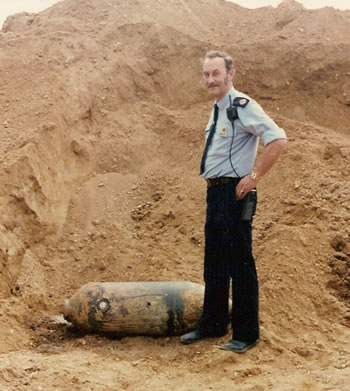
One of the last of Leigh's village policemen was PC Brian Woollett, serving at a time when the old tradition was drawing to a close. By the later decades of the twentieth century, the individual village constable, living in the heart of the community he policed, had largely given way to modern methods and centralised organisation. Yet the memory of men like Austin, Post, Ginn, Cornelius, Stevens and Woollett remains strong in Leigh, a reminder of nearly a century in which the village bobby was neighbour, guardian and friend to the people of the parish.