Victorian
Among the many organisations that once brought village life together in Leigh, few were as popular or as long-lived as the Band of Hope. This was not a local invention: it was a national movement, born in the middle of the nineteenth century, with a double purpose. On one hand it set out to entertain children with treats and amusements; on the other, it hoped to teach them about the dangers of alcohol and the evils of drink. By the end of Queen Victoria's reign the movement claimed more than three million children across the country, and Leigh played its part. Our village had its own active branch from the 1880s or 1890s, and it continued to run right up until the First World War, and possibly beyond it.
We know a good deal about the branch thanks to two articles printed in the Kent & Sussex Courier in 1906, which recorded its activities in pleasing detail. The first concerns the annual treat. On Tuesday June 5th, 1906, members of the Band of Hope gathered for tea in the Vicarage Grounds, which the Rev. H. R. Collum had kindly lent for the occasion. About 60 children sat down to the meal. When the tea things were cleared away, the whole party moved on to the Iron Room, where a musical entertainment had been arranged.
The programme included two dialogues, 'After the Harvest' and 'Management'. Taking the parts were Arthur Waite, Dudley Pankhurst, Alice Hayter, Charlie Hayter, Elsie Young, Daisy Stubbings and Emma Gardner. Music filled the gaps between the spoken pieces: songs came from Mabel Orrom, Alan Young played a solo, and Mrs Pierson and Nora Card joined voices for a duet. The Rev. H. R. Collum took the opportunity to remark that membership of the Band of Hope then stood at 83, and a vote of thanks was passed to Miss Collum in recognition of her part in the proceedings.
The second Courier article describes a rather grander adventure: an outing to London for the older children. The travellers assembled at Hildenborough Station, where special carriages had been reserved for them. Once in the capital, their day was packed with sights. They visited the National Gallery and Westminster Abbey, and enjoyed a steamer trip on the river, travelling down to Tower Bridge and back again to Westminster. The party then walked through Hyde Park before taking a 'bus to the zoo. For the journey home they returned by motor bus to Charing Cross, and were back at Hildenborough by 9.25 in the evening — a long and memorable day for village children of that era.
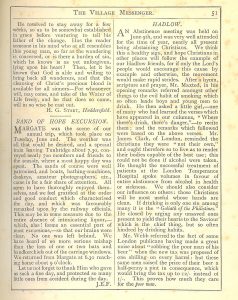
Other glimpses of the branch survive. The Village Messenger for 1885/1886 carried an account of a Band of Hope excursion, and a Certificate of Merit dated 1912 was awarded to Florence Hostler, a touching survival from the movement's later years in the village. A Band of Hope Certificate of Merit such as hers reminds us how seriously the temperance message was taken, even as the children enjoyed their teas, entertainments and days out. This article was published in the Parish Magazine in November 2014.